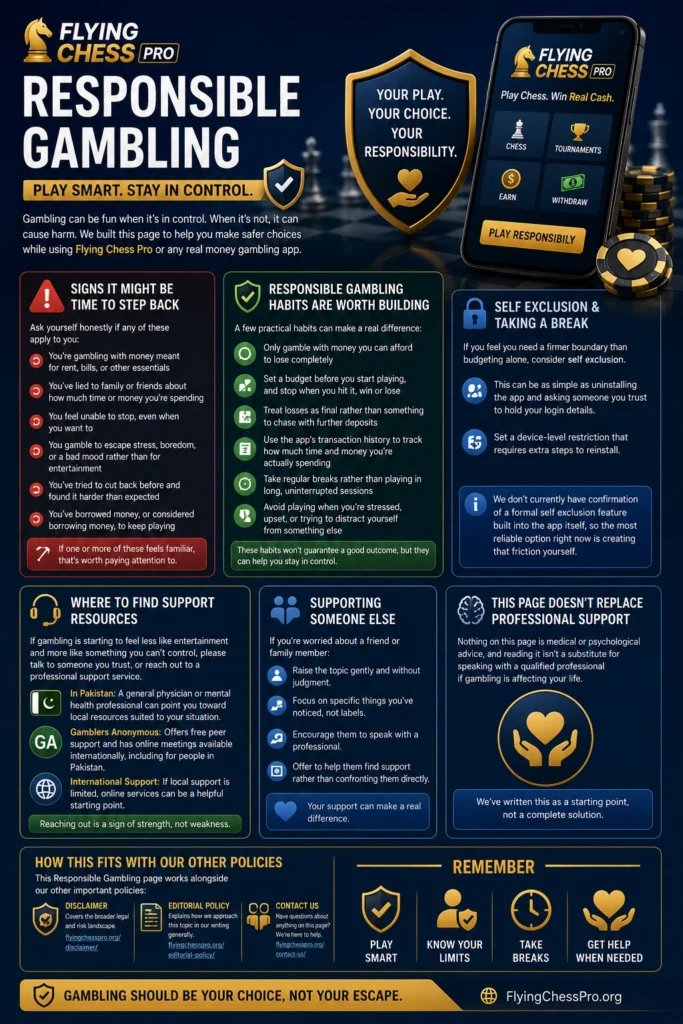
This page brings together our Flying Chess Pro responsible gambling guidance in one place, rather than scattering it across other pages. If you use this app, or any real money gambling app, we’d encourage you to read through this before you deposit anything.
Last updated: October 2026
Table of Contents
Why we built a dedicated responsible gambling page
Gambling can cause real financial and psychological harm, including addiction, and we don’t think a single line buried in a disclaimer is enough to take that seriously. This page exists so that anyone concerned about their own gambling, or someone else’s, has somewhere clear to go on this site rather than having to dig through legal boilerplate to find something useful.
We also think it’s worth saying plainly: writing guides about how to download and use Flying Chess Pro doesn’t mean we think gambling is risk-free, or that everyone who plays will have a good experience. This page is where we try to be most direct about the Flying Chess Pro gambling risks involved, alongside where to turn if things start feeling unmanageable.
Signs it might be time to step back
Ask yourself honestly whether any of the following apply to you:
- You’re gambling with money meant for rent, bills, or other essentials
- You’ve lied to family or friends about how much time or money you’re spending
- You feel unable to stop, even when you want to
- You gamble to escape stress, boredom, or a bad mood rather than for entertainment
- You’ve tried to cut back before and found it harder than expected
- You’ve borrowed money, or considered borrowing money, to keep playing
If one or more of these feels familiar, that’s worth paying attention to, not ignoring or explaining away.
Flying Chess Pro responsible gambling habits are worth building
A few practical habits can make a real difference:
- Only gamble with money you can afford to lose completely; never rent, bill, or borrow money
- Set a budget before you start playing, and stop when you hit it, win or lose
- Treat losses as final rather than something to chase with further deposits
- Use the app’s transaction history to track how much time and money you’re actually spending, since it’s easy to lose track
- Take regular breaks rather than playing in long, uninterrupted sessions
- Avoid playing when you’re stressed, upset, or trying to distract yourself from something else
None of these habits guarantee a good outcome; gambling is inherently risky by design, but they can help you stay in control of the decision rather than the app controlling it for you.
Flying Chess Pro self exclusion and taking a break
If you feel like you need a firmer boundary than budgeting alone, Flying Chess Pro self exclusion, meaning deliberately locking yourself out of the app for a period of time, is worth considering. This can be as simple as uninstalling the app and asking someone you trust to hold your login details, or setting a device-level restriction that requires extra steps to reinstall it. We don’t currently have confirmation of a formal self exclusion feature built into the app itself, so the most reliable option right now is creating that friction yourself.
Where to find Flying Chess Pro support resources
If gambling is starting to feel less like entertainment and more like something you can’t control, please talk to someone you trust, or reach out to a professional support service. Beyond the app itself, there are broader flying chess pro support resources worth knowing about, including general addiction support services rather than app-specific ones.
If you’re in Pakistan, a general physician or mental health professional can point you toward local resources suited to your situation. If international support is more accessible to you, Gamblers Anonymous offers free peer support and has some reach outside the United States, including online meetings that don’t require an in-person visit, and can be a starting point for flying chess pro addiction help if things have gone beyond what budgeting and self exclusion can manage on their own.
Supporting someone else
If you’re worried about a friend or family member rather than yourself, it can help to raise the topic gently and without judgment, focusing on specific things you’ve noticed rather than labels. Encouraging them to speak with a professional, and offering to help them find support rather than confronting them directly, tends to be more effective than pressure alone.
This page doesn’t replace professional support
Nothing on this page is medical or psychological advice, and reading it isn’t a substitute for speaking with a qualified professional if gambling is affecting your life. We’ve written this as a starting point, not a complete solution.
How this fits with our other policies
This Flying Chess Pro responsible gambling page works alongside our Disclaimer, which covers the broader legal and risk landscape, and our Editorial Policy, which explains how we approach this topic in our writing generally.
- Disclaimer: https://flyingchesspro.org/disclaimer/
- Editorial Policy: https://flyingchesspro.org/editorial-policy/
If you have questions about anything on this page, contact us through our Contact Us page: https://flyingchesspro.org/contact-us/